I’m not one for the seemingly endless series of over-hyped Idol, Popstars, and X-Factor dross that passes for entertainment. However, I came across something today that really impressed me. A mobile phone salesman from Cardiff belted out a quite amazing, if a touch rough, Nessun Dorma. He even got a tear in Amanda Holden’s eye. Watch and enjoy at YouTube:
Britain’s Got Talent: Paul Sings Nessun Dorma
Britain’s Got Talent Home
Tags: Uncategorized
I’ve recently been wanting to run a few simulations of solar system dynamics to generate data for animations of various phenomena. One of the most used tools for this in astronomy circles has been the SWIFT package by Hal Levison and Martin Duncan. I used a web-hosted version of SWIFT during my studies at Swinburne University (producing graphs such as the one to the right).
Written in glorious Fortran 77, SWIFT could be built with many commercial Fortran compilers including Intel’s Fortran Compiler. I successfully built SWIFT using the Intel compiler although I never used it in anger. I was never able to build it with the GCC 3.x Fortran (g77) because of the code’s use of recursive routines. Two things have changed in this regard:
The enhanced package is called Swifter and is written to Fortran 90 standards. It now compiles with the GCC gfortran compiler with the following change made to the Makefile.Defines:
FORTRAN = gfortran
FFLAGS = -O -ffree-line-length-none
Now I can attack the problem of building funky animations.
Clear skies!
Tags: Astronomy · Computing
A few weeks ago I wrote about my reasons for choosing an image of the volcanic plumes on Io as one of my banner images. The NASA New Horizons mission to Pluto and the Kuiper belt has captured the first movie of one of these plumes. The five images that make up the movie clearly show the motion of material in the plume from the Tvashtar volcano, and the slow rotation of the satellite. I can see one other plume at the 7 o’clock position from Masubi. NASA’s site says there’s another faint plume at 10 o’clock, but I cannot see it.

Clear Skies!
Image credit: NASA/Johns Hopkins University Applied Physics Laboratory/Southwest Research Institute
Tvashtar in Motion
Tags: Astronomy · Images
The sixth of June is a magnificent time for those with a nascent interest in astronomy to get out and see the largest planet in our solar system. The planet is reaching opposition, making it visible all night. You don’t need any great equipment to get an experience similar to the one that Galileo had when he discovered the moons. Essential equipment:
- Eyeballs
- A set of binoculars with 50mm or larger objective (front) lenses; the common variety at this size are labeled 7×50 (7 refers to magnification and 50 the lens diameter in millimetres).
- A clear sky to the east around 8 PM (harder to arrange than the binoculars).
- Some idea where to look.
Read on for help with the last item (at least for Brisbane, Australia)
[Read more →]
Tags: Astronomy

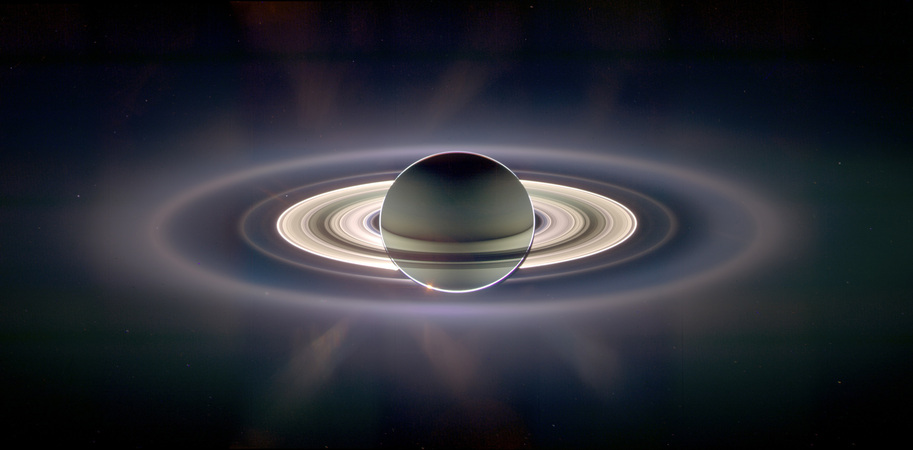
The image is an excerpt from one of the most spectacular Saturn images I have seen. It was snapped by the Cassini-Huygens mission to Saturn on 15 Sep 2006. The image is an enhanced composite of images taken over a twelve hour period as the spacecraft passed through the shadow of the planet. The Sun is backlighting the planet, throwing the rings into a new light and providing scientists an opportunity to study them in new ways.
[Read more →]
Tags: Astronomy · Images